Benchmark Overview
This section presents a performance analysis of the dtFFT library against several alternatives, based on benchmarks conducted on a GPU cluster.
Test Environment
Hardware: 10 nodes, each with 4x NVIDIA Volta V100 GPUs (32 GB HBM2), connected via 56G InfiniBand.
Software: NVHPC 24.7, CUDA 11.8.
Libraries:
dtFFTv2.2.0,cuDECOMPv0.5.1,HeFFTev2.4.1, andAccFFT(latest from repository).Problem Size: A 3D grid of \(1024 \times 1024 \times 512\) was used for all tests.
Methodology: Each benchmark was run for 50 iterations. The reported time is the average wall-clock time per iteration (total time / 50), in milliseconds.
Precision: To ensure a fair comparison with an 8-byte element size,
dtFFTandcuDECOMPwere benchmarked using double-precision, whileHeFFTeandAccFFTused single-precision complex-to-complex transforms.Communication Backend: For
dtFFTandcuDECOMP, theNCCLbackend was manually selected for inter-GPU communication, as it is known to be the most performant on this hardware. The backend auto-tuning feature was therefore not utilized. In contrast,HeFFTeandAccFFTrely on a CUDA-aware MPI implementation with UCX for data transfers.
Strong Scaling Analysis
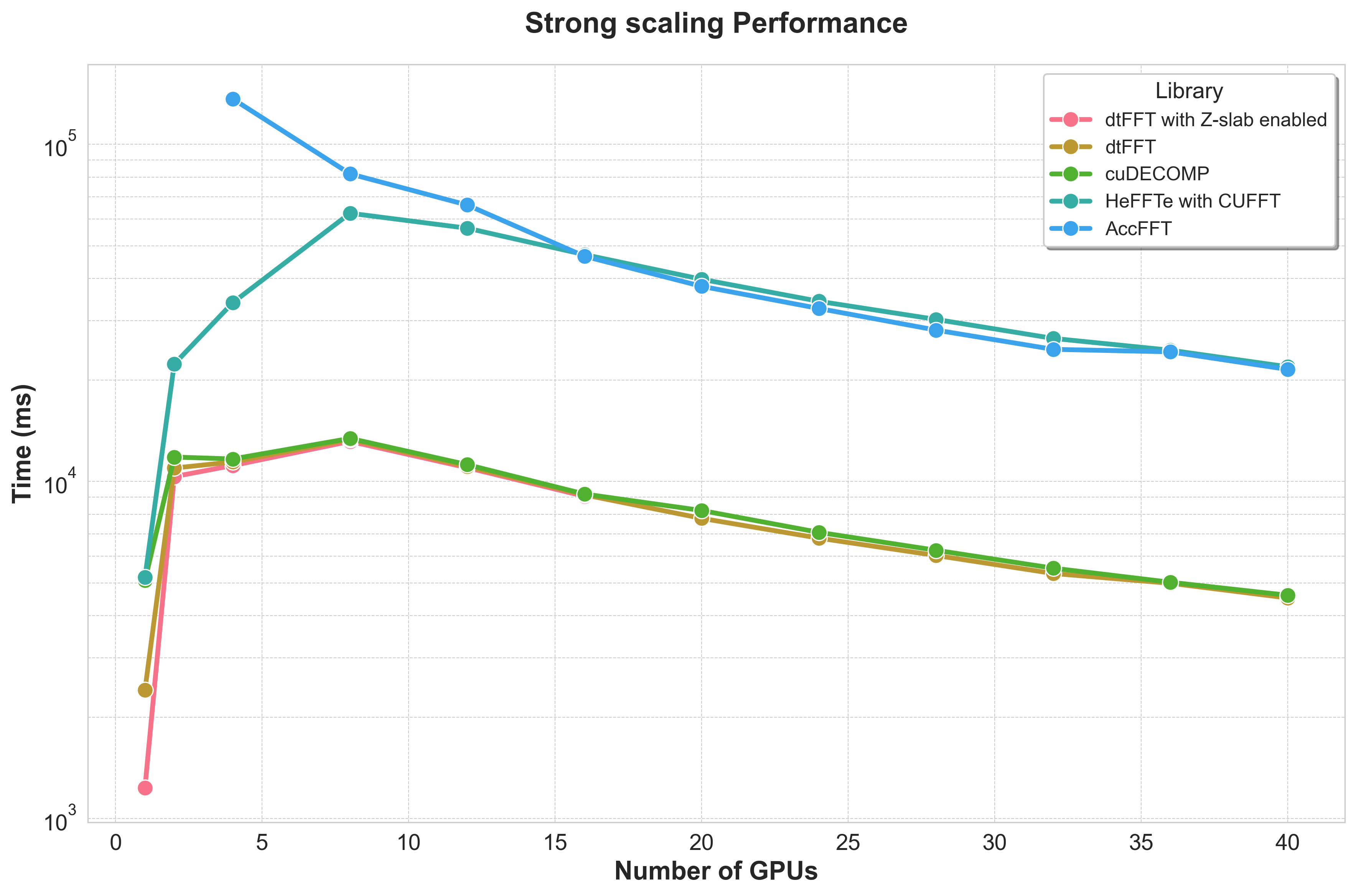
Strong scaling evaluates performance by keeping the total problem size constant while increasing the number of GPUs. The results clearly demonstrate the impact of the underlying hardware communication topology.
1 GPU (Baseline): With no inter-GPU communication,
dtFFTwith Z-slab optimization delivers the fastest performance (1233 ms), establishing a strong baseline.2 GPUs (Intra-Socket, PCI-e v3): At two GPUs, communication occurs over the PCI-e v3 bus. The high cost of this communication channel outweighs the benefits of parallelization, leading to a significant increase in runtime across all libraries. This is an expected bottleneck for this hardware configuration.
4 GPUs (Inter-Socket): With four GPUs, communication extends across two CPU sockets. While performance improves relative to the 2-GPU case for some libraries, the overhead remains substantial.
8+ GPUs (Network, InfiniBand): When scaling to 8 or more GPUs, communication shifts to the 56G InfiniBand network. The benchmark shows that
dtFFTandcuDECOMPscale effectively in this regime, indicating that the network interconnect is well-suited for this workload.
Weak Scaling Analysis
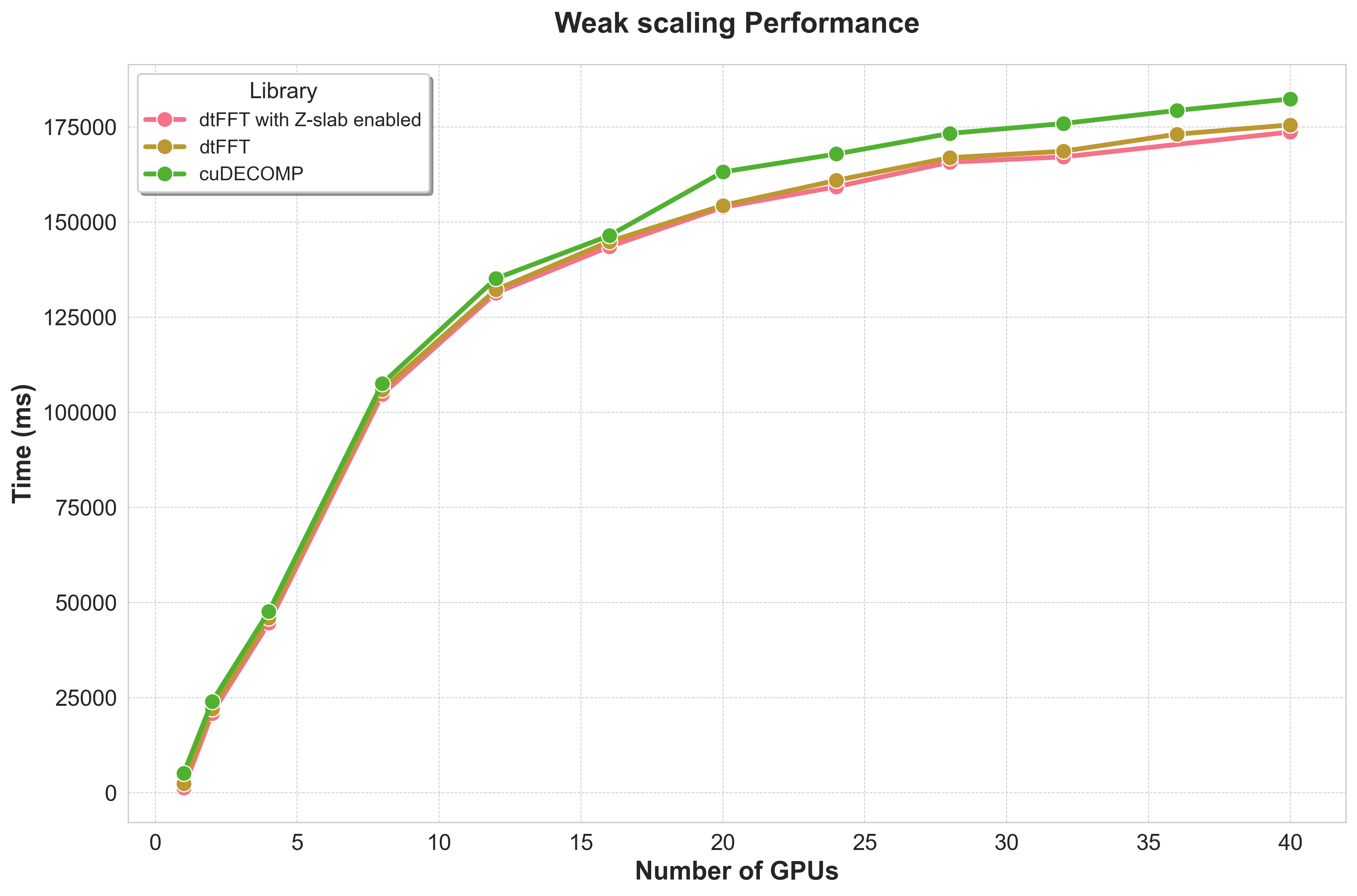
Weak scaling assesses performance by increasing both the problem size and the number of GPUs, keeping the workload per GPU constant.
HeFFTe and AccFFT were excluded from these tests due to their lower relative performance and because their MPI-based data management led to GPU memory exhaustion as the problem size increased.
Performance Trend: As expected, runtimes gradually increase with the number of GPUs. This reflects the inherent cost of synchronizing a larger number of distributed processes over the network.
Comparative Performance:
dtFFT(both variants) andcuDECOMPexhibit very similar scaling behavior, confirming thatdtFFTis highly efficient for large, distributed problems.
Detailed Performance Data
The following tables present the complete timing data from our benchmark runs, serving as the foundation for the analysis above. All times are reported in milliseconds.
The Strong Scaling table illustrates the time-to-solution for a fixed problem size as more GPUs are added. This measures how well the libraries handle parallelization.
Number of GPUs |
dtFFT with Z-slab enabled |
dtFFT |
cuDECOMP |
HeFFTe with CUFFT |
AccFFT |
|---|---|---|---|---|---|
1 |
1233 |
2406 |
5089 |
5194 |
|
2 |
10341 |
10963 |
11818 |
22308 |
|
4 |
11157 |
11433 |
11667 |
33943 |
136429 |
8 |
13152 |
13327 |
13423 |
62498 |
81778 |
12 |
10988 |
11087 |
11221 |
56414 |
66110 |
16 |
9043 |
9130 |
9182 |
47118 |
46586 |
20 |
7776 |
8204 |
39805 |
37936 |
|
24 |
6793 |
7067 |
34249 |
32609 |
|
28 |
6034 |
6253 |
30260 |
28131 |
|
32 |
5336 |
5533 |
26578 |
24664 |
|
36 |
4990 |
5025 |
24519 |
24251 |
|
40 |
4515 |
4599 |
21898 |
21506 |
The Weak Scaling table shows the time-to-solution as the problem size grows proportionally with the number of GPUs, keeping the workload per GPU constant. This measures scalability for larger problems.
Number of GPUs |
dtFFT with Z-slab enabled |
dtFFT |
cuDECOMP |
|---|---|---|---|
1 |
1233 |
2406 |
5089 |
2 |
20833 |
22035 |
23930 |
4 |
44643 |
45920 |
47634 |
8 |
104696 |
105888 |
107538 |
12 |
131328 |
132175 |
135118 |
16 |
143514 |
144869 |
146405 |
20 |
153856 |
154343 |
163137 |
24 |
159255 |
160935 |
167862 |
28 |
165720 |
166899 |
173269 |
32 |
167104 |
168581 |
175875 |
36 |
173065 |
179312 |
|
40 |
173651 |
175504 |
182334 |
Conclusions
Z-Slab is Key for Single-GPU: The Z-slab optimization provides a critical performance advantage when communication is not a factor.
Hardware Topology is Dominant: The performance curve is dictated by the communication hierarchy: intra-GPU is fastest, followed by network (InfiniBand), with PCI-e and inter-socket communication proving to be significant bottlenecks for this problem size.
Excellent Multi-Node Scalability:
dtFFTdemonstrates strong scalability and is highly competitive withcuDECOMPin multi-node environments (8+ GPUs).